Have you ever wondered why the same spray tan solution can look slightly different on different people?
It’s simply because we all have different skin, different natural pigmentation, hormones and different ways our skin responds.
Understanding this is one of the little things that can help create a beautiful, natural looking glow.
This is where the Fitzpatrick Skin Type Scale comes in.
What is the Fitzpatrick Scale?
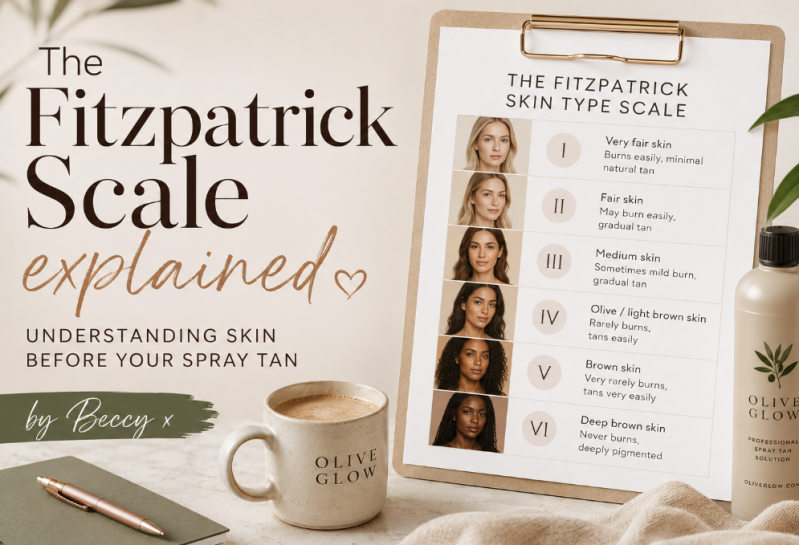
The Fitzpatrick Scale is a way of describing different skin types based on how they naturally respond to UV exposure.
It looks at things like how easily someone burns and how easily they naturally develop colour.
There are six skin types, ranging from very fair skin that tends to burn easily, through to deeper skin tones with more natural pigmentation.
For spray tanning, it’s not about putting people into boxes.
The 6 Fitzpatrick Skin Types
Type I
Very fair skin that often burns easily and usually develops little natural colour from the sun.
Type II
Fair skin that can burn easily but may develop some colour.
Type III
Medium skin that may gradually develop colour.
Type IV
Often olive or light brown skin that tends to tan more easily.
Type V
Brown skin tones with naturally higher levels of pigmentation.
Type VI
Deep brown skin tones with naturally higher levels of pigmentation.
Every skin type can enjoy a spray tan.
The important part is creating a result that the client feels confident wearing.
Does your Fitzpatrick type decide your tan shade?
No, and this is where a lot of people get confused.
A client doesn’t usually come in saying:
“I’m Type II and I want a medium tan.”
They usually say:
“I want dark.”
“I want a holiday glow.”
“I want to look bronzed.”
And that’s where the consultation comes in.
Someone with fair skin may love a deeper glow.
Someone with naturally deeper skin may want a softer, more subtle enhancement.
The Fitzpatrick scale helps us understand the skin, but the client’s desired result is just as important.
So how does a spray tan actually work?
The colour you see immediately after a spray tan is usually the guide colour.
This helps the artist see where the solution has been applied and gives that instant bronzed feeling.
At Olive Glow, we use a universal brown bronzer approach because we love that natural, believable glow.
But the guide colour is not the developed tan.The developed colour comes from DHA.
DHA (dihydroxyacetone) reacts with the outer layer of the skin to create the temporary colour we recognise as a spray tan.
That’s why your tan continues to develop after your appointment, even once the guide colour has been washed away.
Does everyone develop the same colour?
No.
And that’s the beauty of spray tanning.
The final result can be influenced by things like:
✨ your natural skin pigmentation
✨ your skin preparation
✨ the solution used
✨ development time
✨ the result you are hoping for
This is why a professional spray tan isn’t just about picking the darkest shade.
It’s about creating the glow that suits you.
DHA percentages explained
DHA percentage can be used as a guide when choosing a solution.
A lower DHA can be a great option for someone wanting a softer, more natural glow.
A medium DHA can create that classic bronzed look.
A higher DHA can be chosen when a deeper result is wanted.
But higher doesn’t always mean better.
The best result is the one that looks beautiful on the person wearing it x
Beccy’s tips 🤎
✨ Always ask your client what their idea of “dark” actually is.
✨ A photo of their dream tan can be more helpful than just choosing a shade name.
✨ Good preparation makes such a difference to the final result.
✨ The goal isn’t to change someone’s skin, it’s to enhance their natural beauty.
✨ Confidence comes from a tan that feels like you.
Final thought's
The Fitzpatrick Scale is a great tool for understanding skin, but spray tanning is about bringing everything together.
Knowledge.
Consultation.
Technique.
The right product.
Because the perfect glow isn’t about being someone else.
It’s about feeling amazing in your own skin ✨
Frequently Asked Questions
Can someone with very fair skin have a dark spray tan?
Yes.
Skin type does not decide what colour someone can enjoy. A consultation helps create a result that matches the client’s wishes.
Is the bronzer the actual tan?
No.
The bronzer is the guide colour you see after application. The developed tan comes from the DHA reaction.
Does a higher DHA mean a darker tan?
Not always.
DHA is one part of the process. Skin and preparation also influence the final result.
Why does the same spray tan look different on different people?
Because everyone’s skin is unique, and the way colour develops can vary from person to person.
Do I need to understand the Fitzpatrick Scale as a spray tan artist?
Understanding skin helps you feel more confident during consultations and helps you create better results.
Add comment
Comments
Thank you